Anxiety Therapy in Portland for LGBTQ+ Adults Who Wonder Why They Still Feel Anxious in Queer Spaces
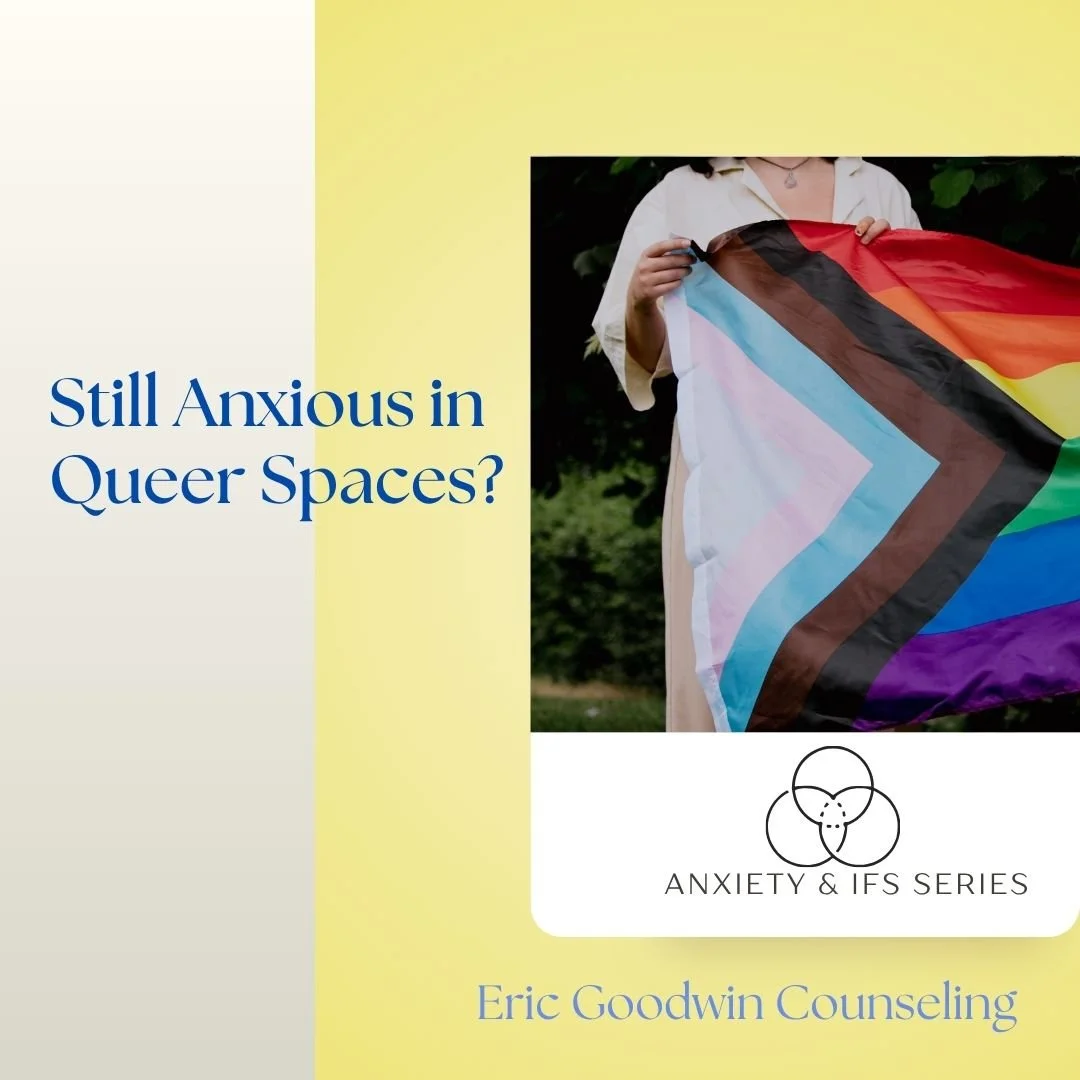
Anxiety in Queer spaces does not mean you are bad at belonging. It may mean parts of you learned to stay guarded for a reason. Therapy for anxiety in Portland and across Oregon supports you in navigating these complicated feelings.
If you’ve been looking for anxiety therapy in Portland and you’re part of the LGBTQ+ community, there’s a pretty high chance you know a specific kind of anxiety that is hard to explain, even to yourself.
It’s one thing to feel anxious in places where you already expect to feel guarded. Most people who are Queer and Trans know something about measuring what feels safe to share, and the broader world gives us plenty of reasons to scan before we can let our guards down.
I want to talk about what happens when that same familiar anxiety shows up in the places you hoped would feel different. The places where, in theory, your body might finally get to exhale a little. But then it starts. You’re trying to be in the room, maybe even trying to enjoy yourself, and some part of you has already gone into quality control mode. You hear yourself say something and immediately start checking it from twelve different angles. Was that weird? Did that land wrong? Are you being too quiet, or have you somehow crossed over into too much? Meanwhile, everyone else seems like they know how to be there, and you’re left wondering if there was some orientation to Queer community that you accidentally missed.
That can be so disheartening. Not just because anxiety is uncomfortable, although, yes, anxiety is plenty uncomfortable. It hurts because you may have been hoping this would be the place where you could finally stop working so hard. Then anxiety shows up there too, and the shame story can get convincing fast. Suddenly, the problem does not feel like anxiety anymore. It feels like you. Like there is something about you that makes belonging harder, even in the places where belonging was supposed to feel more possible.
And I’m curious about just how accurate that story is. Could it it mean something in you is scared, probably for reasons that deserve care instead of another round of self-criticism?Some parts of you may have learned, for very understandable reasons, that belonging isn’t guaranteed. When those parts are trying to protect you, even affirming spaces may not automatically feel safe. This is one specific layer of anxiety I talk about in my broader guide to finding anxiety therapy in Portland.
Queer Spaces Can Be So Needed and Still Feel Complicated
When we zoom out to our collective history, it’s easy to understand why Pride matters. Queer joy and Queer community aren’t small things. Being seen and held by other LGBTQ+ people can be powerful, and for many of us, deeply nourishing.
Pride can also be complicated. You can really want the connection, the celebration, the chosen family piece, all of it, and still find yourself feeling like you’re on the outside looking in. That does not mean Queer community doesn’t matter to you. In fact, it may mean it matters a lot, which is part of why it can hurt so much when being there doesn’t feel as easy or validating as you’d hoped it would. Wanting belonging and being able to relax into belonging aren’t always the same thing.
Sometimes Queer culture gets presented as though we’re all supposed to want the same things and move through the world with the same kind of boldness. Sure, some people do feel that way. Beautiful! Love that for them.
For a lot of us, the actual inner experience is more layered than that. Pride can matter deeply and still bring up a kind of loneliness that feels hard to explain. Queer spaces can be meaningful and still activate those parts of us that are watching the room, trying to figure out whether we’re safe, welcome, or about to somehow “mess up.”
That tension doesn’t mean your destined to feel disconnected from community. It could mean something important may be happening inside that deserves care and attention. Trying to force that part to go away, or piling self-criticism on top of it, usually doesn’t help it let go. If anything, it tends to make the whole thing grip harder.
Feeling Anxious Does Not Mean You Don’t Belong
One of the most painful things about this kind of anxiety is how quickly it can turn into a story about oneself. Not just, “I felt anxious tonight,” but something much more tangled up with how we see ourselves. Something closer to, “What does that say about me?”
That is where shame can really sink in. For a lot of LGBTQ+ people, Queer community carries real hope. It can represent the possibility of finally being around people who get parts of us that have had to be hidden or carefully explained elsewhere. So when we get close to that kind of community and still feel guarded, self-conscious, or “other,” it can feel like a very particular kind of heartbreak.
This was supposed to be where it got easier. And when it doesn’t feel easier, it can be tempting to turn that pain inward. Anxiety starts to feel less like a protective response and more like proof that something is wrong with us. Like you are the one person who cannot figure out how to belong, even in the places where belonging was supposed to be more possible. What if we got curious before accepting that as the final answer?
What I think is more likely is that some parts of us have learned to be careful. Maybe extremely careful. And that would make sense if being fully ourselves has carried risk, whether that risk was direct and obvious or subtle and harder to name. A lot of people learn to scan for safety after years of being taught, directly or indirectly, that some parts of them might cost them connection or lead to more pain and hurt.
So when you walk into Queer community, your nervous system may not simply go, “Great, we’re safe now.” It may still be checking, waiting for evidence and bracing for the moment belonging gets complicated or taken away. (There is also a lot to say about how internalized Queerphobia, homophobia, and transphobia can get expressed inside Queer community itself, but that is probably a whole other blog!)
For now, I want to stay with what this can feel like inside. You might technically be included and still feel separate, “other.” You could be having a mostly okay time, but some part of you is working so hard to track the room that you cannot really show up in the experience. Later, your mind may latch onto the one awkward moment and treat it like the whole story, even if the night held other moments too.
That is painful but it’s not a character flaw. It is what can happen when the desire for belonging meets the parts of ourselves that have learned belonging isn’talways safe. If those parts have been listening for years to the message that love and connection are conditional, of course they’re not going to soften just because we told them this room is different.
Why Your Nervous System May Still Be Scanning
Anxiety can keep us in our heads. Even when we feel it physically, the tight chest, the tense shoulders, the stomach drop, a lot of our attention still gets pulled toward the same question: “What is going wrong here?”
That is one of the hardest parts of social anxiety. You may actually be in the room with people you want to know, people you might like, people who might be available for real connection. But inside, a protective part is working overtime. Not because it wants to ruin your night, but because it is trying to keep you safe.
So instead of getting to simply be with the people in front of you, you may find yourself trying to solve the room. A pause feels loaded. A facial expression becomes a case file. Suddenly your attention is not on connection anymore; it’s on figuring out whether you’re safe here.
That’s part of why an affirming space doesn’t automatically feel safe to every part of you. That does not mean you are dramatic or ungrateful, or that old chestnut of feeling like you are “too much.” It means your system may be trying, in its own exhausting way, to protect you.
The “Queer Enough” Spiral
A lot of us know the feeling of wondering whether we’re “Queer enough,” even if we wouldn’t say it exactly that way. It’s that sense that everyone else understands something you don’t. Like there are rules here, or a rhythm, or a way to belong that other people seem to move with more naturally. When anxiety is online, it can be really easy to look around the room and decide everyone else is relaxed, confident, and completely at home in themselves while you are the only one narrating your every move from inside your head.
Anxiety, bless its heart, is not usually running a very rigorous research study when it starts drawing conclusions about your worth. So the story can become, “I am the problem.” Not, “I feel anxious right now.” Not, “This is vulnerable for me.” Just, “Something about me does not fit.” There may be another way to understand what is happening.
It may be that one part of you really wants to belong, while another part still remembers that belonging has not always been safe. The awkwardness, the guardedness, the wanting to go home and hide under a weighted blanket until further notice, none of that has to mean you are bad at community. It may mean you are doing something vulnerable, and some protective part of you is trying very hard to make sure you do not get hurt.
That does not make the anxiety pleasant but it may make it more understandable. Where there is more understanding, there also tends to be more choice.
The Parts That Show Up Around Queer Community
Internal Family Systems, or IFS therapy, gives us a way to understand this without making anxiety more evidence against you. IFS is based on the idea that we all have different parts of us that can show up in different moments. Most of us already know what it feels like to be pulled in more than one direction.
That push-pull can be so real around community. A part of you wants to go, and another part is already looking for a reason to cancel. A part of you wants to be seen, and another part would strongly prefer to become a houseplant in the corner. A part of you wants connection, and another part is making a pretty compelling argument that staying home would be safer, easier, and less emotionally exhausting.
In IFS, we get curious about that internal tug-of-war instead of treating it like a personal failure. These parts may be trying to help in the only ways they know how. Not necessarily effectively. Not gently. Not in ways that feel especially great to live with. But often with some protective intention underneath.
That matters, because if we only focus on making the anxiety stop, we could miss what the anxiety is trying to protect. A part of you may be trying to prevent rejection, shame, or the very real pain of feeling shunned.
This is one reason I think IFS can be so helpful in counseling for anxiety in Portland, especially for LGBTQ+ adults who are tired of turning every anxious response into proof that something is wrong with them.
IFS helps us get curous about what these parts are afraid of, what they have been carrying, and what kind of support they might need from you now. Not so we can hand them the keys forever, but so you don’t have to keep fighting yourself as the only strategy for getting through.
What If These Parts Are Not Bad?
This is one of the things I focus on the most in therapy: the parts of ourselves that we have assumed are bad, stubborn, embarrassing, dramatic, or broken do not have to be treated that way in our work. We can set the table to better understand them.
Therapy does not have to become another place where you are judged for having the internal experience you are having. Through IFS, mindfulness, and Mindful Self-Compassion, we can start to notice what is happening inside with less fear and more honesty. We can get curious about what anxious parts have learned, what they are trying to protect, and why they may not trust belonging yet.
As those parts feel more understood, there may be more room for choice. A way to say, “A part of me is scared right now, and that does not mean I am hopeless.” And now there is more room for change and inviting in care where there used to be criticism.
LGBTQ+ Affirming Therapy Is More Than Being Welcome
When I talk about LGBTQ+ affirming therapy, I don’t mean every session has to center your Queerness. Sometimes therapy is about work, grief, family, anxiety, relationships, or the deeply annoying way your brain replays a four-second interaction from last Thursday as though it is preparing a legal case.
LGBTQ+ affirming therapy means Queerness is welcomed as part of the whole picture, not assumed, not minimized, and not treated as a side note that only matters if the topic is explicitly about identity. It is also not exaggerated and turned into the entire story.
Your Queer experience may shape how anxiety, belonging, shame, and connection live in your body. Or it may matter more in some moments than others. We get to pay attention without forcing it.
Even though I am Queer myself, I am not going to assume your experience of Queerness is the same as mine. Affirming therapy is not about projecting a script onto you. It is about making room for your actual experience, including the parts that are joyful, guarded, skeptical, tender, or hard to name.
If this season brings up celebration, beautiful. If it brings up grief, loneliness, pressure, or the ache of wanting community to feel easier than it does, that belongs here too.
I think there is something really meaningful, and honestly pretty powerful, about letting Pride include the parts of you that are still learning to trust belonging. Not as some glossy wellness-poster version of healing. More like a real, grounded act of care toward the parts of you that learned to stay guarded for a reason.
You don’t have to treat your anxiety as proof that you are defective. You can begin somewhere gentler: “Of course I’m guarded. I learned to be. And maybe I don’t have to hate myself for that.”
If you are reading this after skipping the event, leaving early, drinking more than you wanted to, or replaying the conversation until it stopped resembling what actually happened, there ain’t no shame in being here. I’m glad you are here.
And if some part of you feels afraid or ashamed to reach out for therapy, that part is welcome too. I’m here to help with that process and offer a free 15-minute phone consultation to see how I can best support you. Reach out to schedule your consultation by calling (971) 533-5590 or clicking here.
Author Bio

Eric Goodwin, LPC, supports LGBTQ+ adults in Portland and throughout Oregon with anxiety therapy rooted in IFS, self-compassion, and affirming care.
Eric Goodwin, LPC, is a Licensed Professional Counselor who offers online anxiety therapy in Portland and throughout Oregon. Eric works with adults navigating anxiety, self-doubt, harsh self-criticism, high internal pressure, identity-related stress, and the tender work of wanting connection while feeling guarded around belonging. Their approach integrates Internal Family Systems, Mindful Self-Compassion, Person-Centered Therapy, and LGBTQ+ affirming therapy. Eric is especially passionate about helping Queer clients understand the parts of themselves they have been taught to judge, so they can build more self-trust, more compassion, and a little more room to exhale.
Frequently Asked Questions About Anxiety Therapy in Portland for LGBTQ+ Adults
Is it normal to feel anxious in Queer spaces?
It sure is! And I know that answer may feel both relieving and disappointing. A lot of people hope Queer spaces will feel immediately easier. Sometimes they do. Sometimes they do not. If your system has learned to scan for rejection or exclusion, that learning may come with you into spaces you genuinely want to be part of.
That does not mean you are doing community wrong. It means some part of you may need more support before connection feels safe enough to let in.
How can IFS therapy help with this kind of anxiety?
IFS therapy can help by shifting the question from “What is wrong with me?” to “What is happening inside me?”
That may sound simple, but it can be a big shift. Instead of treating anxiety as one big problem, we can begin to notice the parts involved. You might have a part that scans the room, a part that wants to hide, and a part that criticizes you afterward because it believes that will somehow keep you safer next time. As those parts feel more understood and supported, they often do not have to work quite so intensely.
What does LGBTQ+ affirming anxiety therapy mean in your practice?
In my practice, LGBTQ+ affirming therapy means Queerness is welcomed as part of the full picture of who you are.
It does not mean we have to focus on identity in every session. It means we do not have to pretend identity is irrelevant when it is shaping anxiety, belonging, shame, relationships, or self-understanding. It also means I will not assume your Queer experience is the same as mine or ask you to fit a particular narrative about what Queerness should mean to you.
Can therapy help if I’m avoiding events or replaying everything afterward?
Yes. Avoidance and replaying often make sense as protective strategies, even when they become painful or limiting.
A part of you may avoid events because it is trying to protect you from overwhelm or rejection. Another part may replay everything afterward because it believes that reviewing every detail will help prevent future pain. In therapy, we can understand those parts, support them differently, and create more room for choice around connection.