How LGBTQ+ Affirming Care Changes an Anxiety Therapy Session in Portland
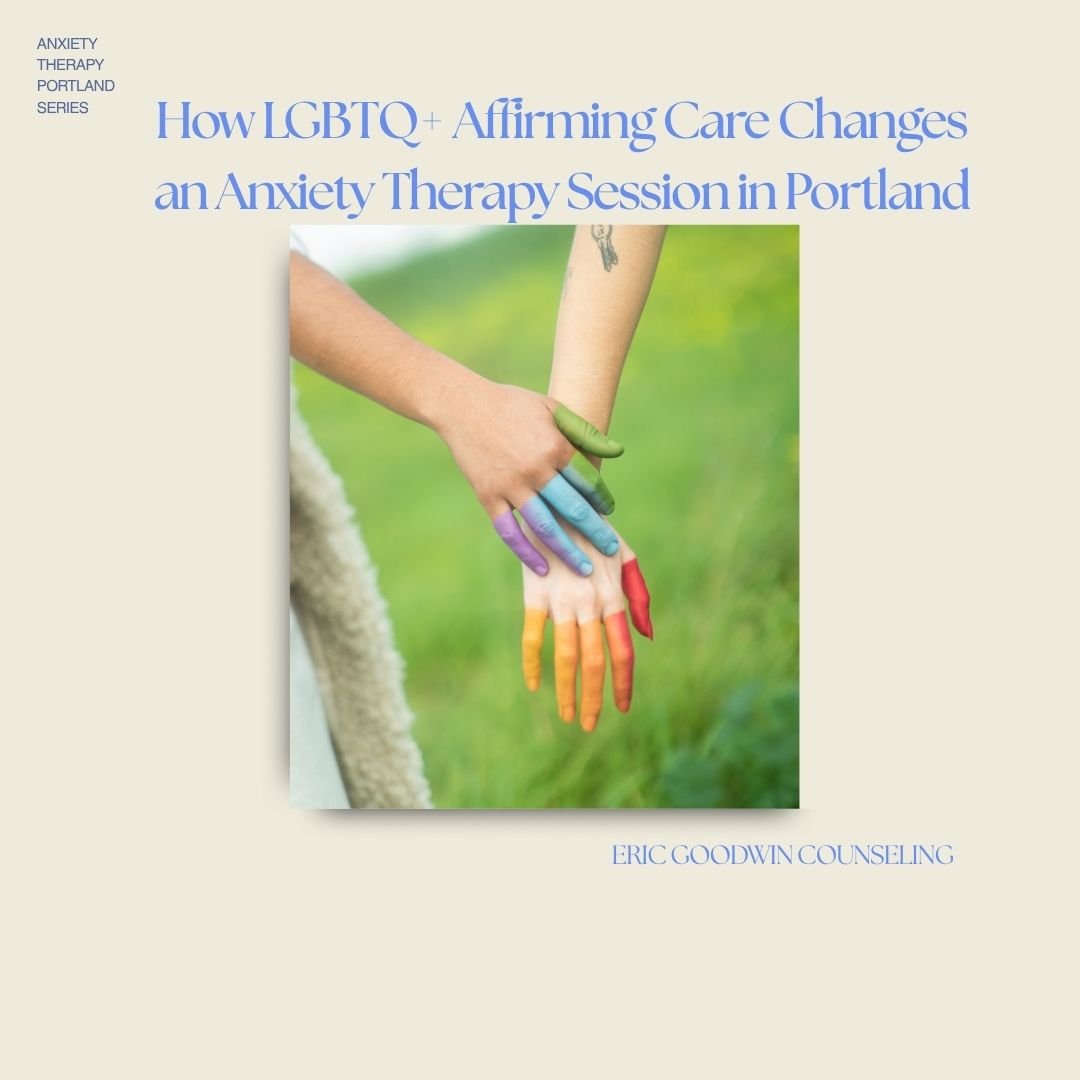
LGBTQ+ affirming anxiety therapy should do more than signal acceptance. It should help make sense of anxiety in context, without requiring you to translate your experience or making your identity explain everything.
For many in the Queer community, the search for anxiety therapy in Portland doesn’t start with symptoms. Sometimes the extra work starts before you even get to the thing you came in to talk about. You’re explaining why a particular interaction stayed with you, filling in context you’re not sure your therapist understands, or deciding whether correcting an assumption is worth interrupting the conversation. Part of your attention is on what you’re feeling. Another part is keeping track of whether the person across from you understands the world that feeling is happening in.
For LGBTQ+ clients, that kind of monitoring can become so familiar that it barely registers. You may have spent years reading a room before deciding what to say, letting an assumption pass because correcting it felt like more trouble than it was worth, or learning that being misunderstood sometimes carries consequences beyond an awkward conversation. Those habits don’t automatically disappear because you’ve entered a therapist’s office.
They also don’t tell us, by themselves, what any particular anxious response means. Anxiety may be picking up on something important in the present, expecting an old situation to repeat itself, or doing both at once. I want to understand what the anticipation behind the anxiety is all about, what is actually happening now, and where those two things have gotten tangled together.
Being LGBTQ+ may be central to that story in one part of your life and barely relevant in another. Anxiety can also be tied up with family, relationships, perfectionism, shame, work, earlier experiences, or something that has very little to do with identity at all. Affirming therapy shouldn’t require you to choose between having your identity understood and being treated as a whole person.
In my work, I’m interested in what an anxious or protective response is trying to prevent and why it has needed to work as hard as it does. We can take identity-related stress seriously without automatically treating vigilance as a problem to eliminate, while still noticing when an old protective pattern is taking over in a situation that may no longer require the same response..
How Affirming Care Changes the Questions We Ask About Anxiety
If you tell me that you spent a meeting watching everyone’s reactions instead of saying what you wanted to say, there are several ways I could understand that. I could call it social anxiety and move immediately toward helping you speak up more. I could also assume the room felt unsafe because you’re Queer. Both conclusions would be too fast.
Before deciding what needs to change, I want to understand what was actually happening. That includes what you noticed in the room, what you were expecting from the other people there, whether something similar has happened before, and what staying quiet helped you avoid. The fact that a response is painful or limiting now doesn’t tell us where it came from.
Someone who has learned to pay close attention to tone, expressions, or the language other people use may have had good reasons for becoming skilled at reading a room. There may also be times when that same monitoring starts automatically with people who have given you very little reason to expect a problem. If we treat all of it as irrational anxiety, we miss part of the story. If we assume all of it is necessary self-protection, we may miss where your life has changed.
I also don’t want LGBTQ+ identity to become the explanation we reach for every time something is difficult. Your anxiety before a work meeting might have much more to do with perfectionism, an unpredictable boss, or how hard it is for you to disappoint someone. In another situation, being Queer or trans may be inseparable from what you’re worried about. I want us to be able to tell the difference rather than deciding ahead of time which explanation is supposed to fit.
We can understand why a response makes sense before asking whether it is still helping you now, and we can experiment with doing something different without pretending the part of you that learned to be careful never had a reason to exist.
When Anxiety Has Learned to Watch for Danger
Some anxious responses are easy to recognize because they feel obviously uncomfortable. Others are woven into the way you move through the world. You notice who is in the room before you relax. You rehearse how you’re going to say something before deciding whether to say it at all. You catch a change in someone’s tone and start working out what it means before they’ve finished the sentence.
If you’ve had experiences where being misread, dismissed, judged, or too visible carried a real cost, paying close attention may have helped you protect yourself. The problem is that a response can keep doing its job long after the conditions around it have changed. Your nervous system doesn’t necessarily get an updated memo every time you enter a safer relationship or a different environment.
In an anxiety therapy session, I’m not interested in arguing with that vigilance or congratulating it for being protective. I want to know what it is expecting and what it believes would happen if it stopped paying such close attention. With Internal Family Systems (IFS therapy), we can get curious about the part of you that learned to monitor, prepare, or stay one step ahead rather than treating it like an obstacle we need to push past.
That can bring up an important difference between being safe enough now and believing that you are. A part of you may understand intellectually that this therapist, relationship, workplace, or community is different from something you went through before and still not be ready to stop scanning for trouble. I don’t think forcing reassurance on that part is especially useful. I’d rather understand what evidence it is looking for and let trust develop from what actually happens.
Sometimes that means noticing, in the session itself, what happens when you disagree with me, correct something I misunderstood, say you don’t know what you feel, or decide you don’t want to answer a question yet. Those moments give us more information than a therapist simply telling you that you’re safe to be yourself.
When You Don’t Have to Educate Your Therapist
There’s a difference between explaining your experience to a therapist and having to explain Queer experience well enough for the therapist to follow the conversation. I expect you to tell me what something meant to you. I don’t expect you to stop in the middle of that story to provide a primer before we can talk about why it hurt.
That changes how much of the session can stay focused on you. If you’re talking about a family relationship, for example, I want to be paying attention to what happens inside you as we talk about it, not leaving you to wonder whether I understand why a particular comment landed differently than it might have for someone else. When identity-related stress is part of the anxiety, we should be able to work with it as part of the experience rather than repeatedly stopping to establish that it belongs in the conversation.
I’m Queer myself, but that doesn’t mean your experiences will look like mine or that I already know what something meant to you. Shared identity can offer some common ground, but it isn’t a shortcut around curiosity. I’m going to misunderstand things sometimes, including things that have nothing to do with being LGBTQ+. What I don’t want is for you to become responsible for protecting me from knowing I got something wrong or reassuring me that I’m still a good therapist after you correct me.
If we don’t have to keep interrupting the work to establish basic context, we can stay closer to what is actually happening for you. We can notice when anxiety is pulling you toward hiding, preparing, pleasing, or bracing for the next problem, and we can understand those responses without making you translate them first.
When You’re Not Sure Whether It’s Anxiety or Bias
There are situations where you may genuinely not know what someone else meant. A coworker’s reaction changes after you mention your partner. Someone uses language that leaves you wondering whether they were being careless or making a point. You leave the interaction replaying it, trying to decide whether something happened or whether anxiety has taken over the investigation.
I don’t think an affirming therapist should rush to settle that question for you. Telling you that you’re probably imagining bias can dismiss experiences you’ve had good reason to take seriously. Automatically deciding that bias must be the explanation can also strengthen anxiety’s belief that uncertainty needs to be solved before you can feel okay.
We may know what happened, have enough information to make a reasonable judgment, or be left with the uncomfortable truth that another person’s motives simply aren’t available to us. Therapy can help us look closely at what you noticed, what meaning your mind made from it, and what happened next without pretending we have certainty that isn’t there.
For someone who has experienced rejection, discrimination, or the consequences of being misread, uncertainty itself can become difficult to tolerate. Anxiety may keep going back over the interaction because it believes another round of analysis will finally tell you whether you were safe, whether you should have responded differently, or what you need to prepare for next time. Understanding why that checking developed doesn’t require us to let it keep you stuck there.
Affirming therapy should be able to take the possibility of identity-based harm seriously while also helping you notice when anxiety is asking you to know something you cannot actually know. I think both are necessary if therapy is going to respect your experience without turning fear into the final authority on what happened.
What Progress Can Look Like in LGBTQ+ Affirming Anxiety Therapy
If counseling for anxiety in Portland is helping, I’m not looking for evidence that you’ve stopped noticing risk or that situations that once made you anxious suddenly roll off your back. I’m paying attention to what happens after anxiety gets your attention. I’m paying attention to whether anxiety immediately takes over the investigation or whether you can stay curious long enough to decide what you actually want to do.
Someone’s tone can change and you can notice it without spending the rest of the evening reconstructing the conversation. Or something genuinely does feel off, and instead of arguing yourself out of your reaction, you take it seriously and decide how you want to respond. There’s a meaningful difference between trusting every alarm anxiety sounds and learning that you can trust yourself to figure out what deserves your attention.
Some of that work happens right between us. When you disagree with me or tell me I misunderstood something, we get to find out what your mind expects will happen next. If you notice yourself starting to build a case for why your reaction makes sense, we can pay attention to that too. These are chances to test some of the expectations you carry into relationships rather than only talking about them.
I wouldn’t want therapy to train the perceptiveness or caution out of you. Those capacities may have served you well, and there will still be situations where you need them. I’m more interested in helping you recognize when paying close attention is useful and when anxiety has turned it into a full-time job. Over time, I want that vigilance to become something you can use rather than something that automatically takes over. You can notice what might be happening, take your own reaction seriously, decide what comes next, and trust yourself afterward.
If This Is How You Want to Work With Anxiety
As a Queer therapist, I offer LGBTQ+ affirming therapy for people who want identity to be understood as part of their life without having every struggle explained through it.
I offer online anxiety therapy in Portland and throughout Oregon to adults who are dealing with anxiety, self-criticism, identity-related stress, and the exhausting effort of trying to stay one step ahead of what might go wrong. My approach to counseling for anxiety is LGBTQ+ affirming and often includes IFS therapy and mindfulness and self-compassion. We can take seriously what your anxious or protective responses have learned without assuming they should keep making every decision for you.
I offer a free 15-minute phone consultation if you’d like to tell me a little about what’s been happening, ask questions about how I work, and see whether talking together feels like a good fit.
Schedule your free consultation by calling me at (971) 533-5590 or contact me here.
Frequently Asked Questions About LGBTQ+ Affirming Care in an Anxiety Therapy Session
What if my anxiety isn’t irrational?
Then I don’t want us to pretend that it is. Anxiety can develop around things that actually happened and risks you may still have to navigate. I’m interested in what your anxiety is noticing, what experience has taught it to expect, and whether the amount of protection it is asking for fits what is happening now. A response can have very understandable origins and still become exhausting when it starts showing up everywhere.
What if I want LGBTQ+ affirming therapy but don’t want every problem connected to my identity?
I wouldn’t want that either. Being Queer may shape some experiences without becoming the organizing explanation for your whole life. A difficult interaction at work might involve bias, but it might also involve an unpredictable boss, perfectionism, fear of conflict, or several things that are hard to separate neatly. I want identity to be available as context when it belongs there, not imposed as the answer before we’ve understood what happened.
Can therapy help me become less watchful without teaching me to ignore real risk?
That tension deserves some care. If paying close attention has helped you recognize when a situation wasn’t safe, I don’t want to train you out of trusting your own perception. We can look at when that watchfulness is giving you useful information and when it has become so constant that anxiety is making decisions before you’ve had much chance to see what is actually happening. Over time, I want you to be able to use your awareness without feeling ruled by it and trust yourself after you decide how to respond.

Eric Goodwin is a Licensed Professional Counselor in Oregon and offers online therapy in Portland and throughout Oregon.
Eric works with adults navigating anxiety, harsh self-criticism, high internal pressure, and identity-related stress. His approach is warm, affirming, and focused on helping people better understand themselves while creating more room for ease, clarity, and self-trust.
He offers support for anxiety, LGBTQ+ affirming counseling, and Internal Family Systems, IFS. You can learn more about Eric here.