Is Chaos Overtaking Clarity?: Anxiety Therapy in Portland for Mental Overload
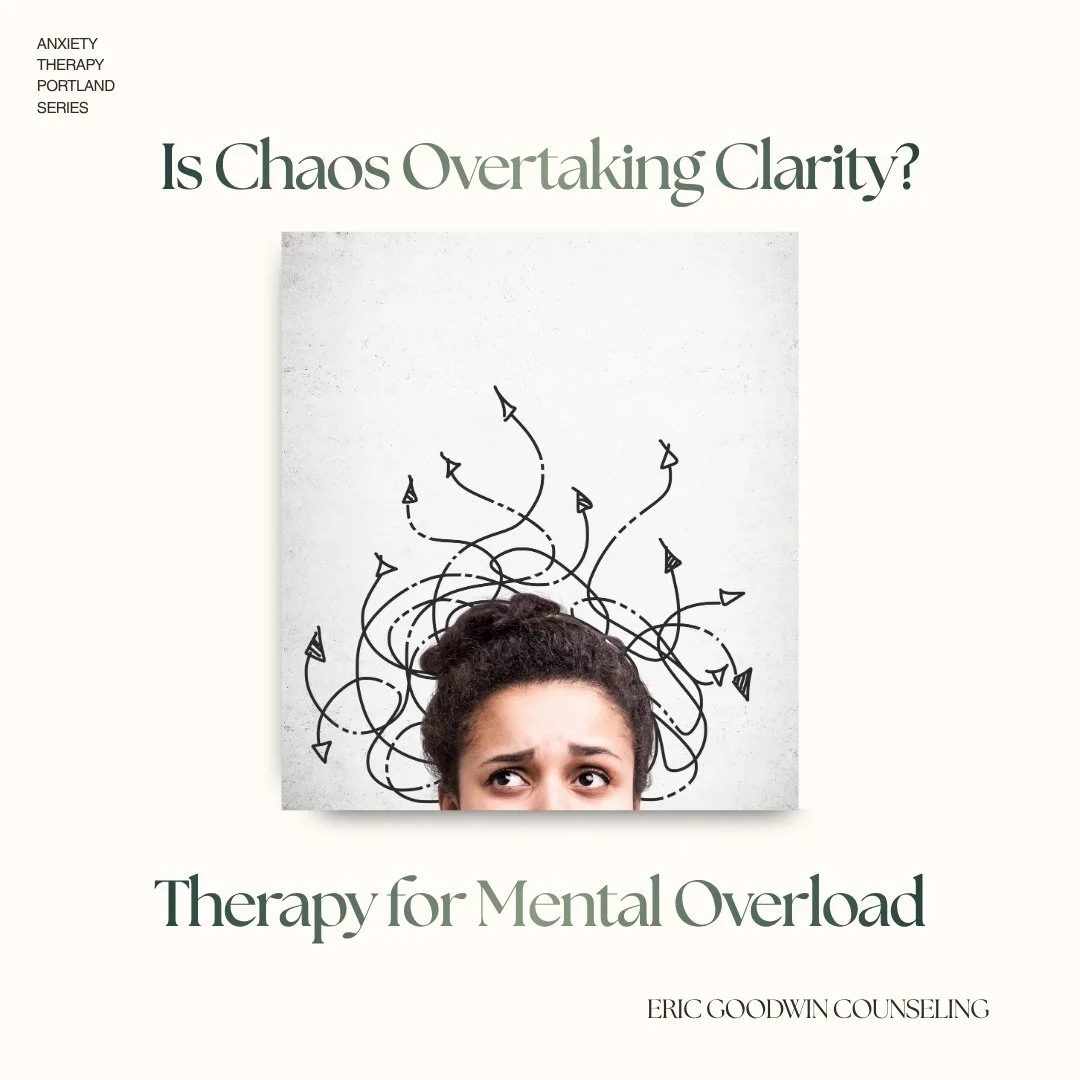
When anxiety keeps your mind working overtime, concentrating, prioritizing, and even unwinding can start taking more effort. Therapy for anxiety can offer a place to understand what has been taking up so much mental space. I offer anxiety therapy in Portland and throughout Oregon.
When anxiety has been taking up a lot of your mental space, sitting down to get a handle on your week can give you some pretty clear signs that your mind is on overload. You look at your calendar and see an appointment that needs to be moved, a work deadline with too many steps involved, projects you can’t even imagine getting started on, and a bunch of things you’re now worried you’ll forget. If you could zoom out for a minute, each of these things on its own would probably be manageable. But your mind has already been through it with worry, anticipation, looping thoughts, and all the effort of trying to stay ahead. There just doesn’t seem to be much space left to decide where to put your attention.
This is exhausting. It’s also one of the side effects of periods of anxiety that can get overlooked in favor of the more obvious symptoms that bring us to therapy or the psychiatrist’s office. When we’re really going through it with anxiety, it can start to feel more like a state of being than a series of anxious moments. All of those ordinary tasks, decisions, deadlines, and responsibilities get caught up in the same swirl, and it can become surprisingly hard to tell what needs your attention now, what can wait, or where to even begin. It’s truly disorienting.
It’s not for lack of thinking about things. Hell, there’s plenty of thinking happening. Your mind keeps circling around what needs to happen next and how you’re going to catch up when you already feel behind. Even when you finally sit down to do one thing, it’s not like the rest of the list just settles down. It can feel like trying to concentrate with a construction crew outside your open window.
After a while, that kind of mental load can start messing with the very abilities you’re relying on to get through it. Concentration gets harder. A decision you normally wouldn’t give much thought can suddenly feel strangely complicated. You can spend a lot of energy moving between things without feeling as though you’re actually getting anywhere. And when you’re used to knowing how to manage your life, it can be unnerving to suddenly feel like your own brain isn’t cooperating.
Then it can get personal. Part of you starts pushing harder because falling behind feels like the last thing you can afford, while another part may feel tired enough to want to avoid the whole mess. You can know you’re overwhelmed and still give yourself a hard time for not handling it better. What’s still undone starts to feel like evidence that you’re failing rather than evidence of how much your mind has already been carrying. And the more pressure you put on yourself to get back on top of things, the harder it can become to find any real sense of mental breathing room.
The hopeful part is that feeling this overloaded doesn’t mean you’ve somehow lost the part of yourself that knows how to handle your life. When anxiety isn’t demanding quite so much of your attention, it can become easier to find your footing again and recognize what actually needs you now.
Why Anxiety Can Make It Hard to Think Clearly
Part of what makes anxious mental overload so confusing is that anxiety can interfere with thinking while your mind is working incredibly hard. Those two things can be true at the same time.
Our attention has limits. We can hold only so much information in mind while we’re trying to use it, sort through it, or decide what to do next. Psychologists sometimes call this working memory, but I think of it more simply as the mental space we have available to work with whatever is in front of us. Anxiety can take up some of that space before the task has even begun.
Worry is especially good at doing this because it sort of builds off of itself, humming along collecting concerns like an anxious tumbleweed. The mind keeps a concern active because there still might be something useful to figure out: another possibility you haven’t considered, something you need to prepare for, some way of making the outcome a little more certain. Even when you’ve already thought about the problem a dozen times, there’s that pull to go through it once more because some part of your mind is still treating the thinking as important work.
That helps explain why anxiety can leave you feeling mentally foggy without your mind being remotely inactive. Some of your attention is on the life happening in front of you and some of it is still tied up elsewhere. Researchers studying anxiety and attention have found that this can make it harder to efficiently shift attention, tune out competing information, and hold onto what matters for the task at hand. The effect can become more noticeable when there is already a lot to juggle.
Anxiety doesn’t necessarily stop people from functioning. A lot of anxious people compensate by trying harder. Giving more time and concentration to double-checking and pushing ourselves until things get done. From the outside, the result may look perfectly fine, and let’s face it, in our culture productivity and hard-work is praised and encouraged. What other people don’t see is how much more effort it took to get there.
If you’re still meeting deadlines or showing up where you need to be, it’s easy to tell yourself that you shouldn’t be this exhausted. Getting something done and getting it done without having to use every bit of available mental energy are very different experiences. The first sign that anxiety has become too much doesn’t have to be that your life falls apart, it could be that holding your life together has become a confusing, exhausting, uphill process.
When It’s Hard to Unwind
Once anxiety has been taking up this much mental space, even the things we usually do to clear our heads can get caught up in it. A lot of us know the experience of going for a walk because we desperately need to clear our heads, only to realize ten minutes later that we’ve spent the entire time thinking about the very things we were hoping Once anxiety has been taking up this much mental space, even the things we usually do to clear our heads can get caught up in it. A lot of us know the experience of going for a walk because we desperately need a break, only to realize ten minutes later that we’ve spent the entire time thinking about the same things we were hoping to get away from for a while.
Our bodies are outside moving, but our minds are still working. We remember something we need to take care of and start figuring out when we can fit it in. Then maybe we notice that we aren’t relaxing, which somehow creates its own pressure. Come on, this is supposed to be helping. Now we're taking a de-stressing walk and getting stressed about how bad we are at de-stressing.
That can be pretty demoralizing when we already know ourselves well enough to know what usually helps. There have probably been plenty of other walks where something loosened along the way. We noticed where we were. Our thoughts stopped pressing quite so hard. We came home feeling a little different than when we left. When anxiety is really humming, though, it can be hard to get enough distance from all that thinking for the walk (or the music, the book, the quiet hour we finally carved out) to reach us in the same way.
And this is where anxiety can be particularly sneaky. We finally give ourselves permission to stop working, but some part of the mind is still very much on the clock. It has spent the day trying not to forget anything, fall behind, miss something important, or get caught unprepared. Thirty minutes on a walking trail doesn't necessarily convince it that the coast is clear.
Then we can end up being hard on ourselves for still feeling anxious after doing something “healthy.” The break itself becomes another performance review: I went outside. I took time for myself. Why do I still feel like this?
I think there’s some relief in recognizing what’s happening before adding another item to the self-care list. Sometimes we’re so mentally overloaded that rest has trouble getting our full attention too. That doesn’t make the walk pointless. It helps explain why we can genuinely need a break and still have such a hard time arriving in it.
How Therapy Can Help When Anxiety Crowds Out Clarity
One useful thing therapy can offer an overloaded mind is another place to put some of the thinking. When everything is being held internally, the mind has to keep returning to it so nothing important gets lost. In therapy, some of that jumble can be spoken, heard, questioned, and returned to later. We don’t have to keep the entire thing mentally lit up at the same time.
That gives us a chance to look at one thread without pretending the others have disappeared. Maybe what keeps coming back really does need attention or it has already received hours of attention and still feels unfinished. We can spend some time getting curious about that difference rather than immediately deciding the answer is to think less, worry less, or become better at managing ourselves.
Mindfulness is useful here because it gives us a way to get interested in attention itself. We can notice how quickly the mind gets recruited by a concern, how long it stays there, and what happens when attention comes back to the room, the body, or whatever is actually happening now. Research on mindfulness suggests modest but meaningful support for aspects of executive attention and working memory. I think the lived experience is just as interesting: discovering that attention can be pulled strongly toward a thought without being permanently assigned to it.
IFS therapy brings a different question into the room: what makes this feel so important to keep holding onto? If some part of us has become convinced that staying mentally on top of everything is how we prevent mistakes, disappointment, rejection, or being caught unprepared, simply telling ourselves to let it go probably isn’t going to be very persuasive. What I find useful about IFS here is the framework it gives us for taking these protective reactions seriously instead of treating them as mental clutter we need to sweep away.
There is also the extra weight we add when overload turns into self-criticism. Once the mind is foggy or scattered, it can be remarkably quick to start offering performance reviews: Why am I taking so long? Why can’t I just deal with this? Compassion-focused work gives us another way to look at what that harshness is doing and whether piling pressure onto an already taxed mind is actually helping. Research in this area has found meaningful reductions in self-criticism and increases in the capacity to soothe ourselves, which is especially relevant when anxiety and frustration with ourselves have become tangled together.
None of these approaches needs to become the plan before we know what the problem actually looks like for the person living it. Before deciding whether mindfulness, IFS therapy, compassion-focused work, or something else will frame the counseling, there needs to be enough trust and collaboration to find out what actually fits. The same mental pressure can also start shaping the choices we make, especially when uncertainty begins to feel like something we have to resolve before we can move forward.
The larger hope is not that therapy gives us a perfectly quiet mind or a foolproof way to keep life from becoming overwhelming again. It can give us somewhere to understand what all that mental activity has been doing, what deserves closer attention, and what may have been occupying valuable mental space simply because the mind hasn’t yet felt ready to put it down.
When Your Mind Has Been Carrying Too Much
If your mind has been working this hard for this long, you don’t have to arrive at therapy already knowing exactly what the problem is or how to describe it. Feeling scattered, mentally exhausted, or unable to get enough distance from your own thinking is enough of a place to begin.
I offer anxiety therapy in Portland and throughout Oregon for people who want some help understanding what has been taking up so much mental space. My approach often includes Internal Family Systems (IFS), mindfulness and compassion-focused therapy, and LGBTQ+ affirming care. We can start with what has been happening and see whether working together feels useful.
I offer a free 15-minute phone consultation so we can talk briefly about what has been happening and get a sense of whether we’d be a good fit. To schedule you can click here and set up a time on my calendar or call me at (971) 533-5590 and let’s see how I can help!
Frequently Asked Questions about Anxiety and Mental Overload
Can anxiety make me more forgetful, or could something else be going on?
It can certainly feel that way! When a lot of our attention is already preoccupied with worry, there will be less available for taking in new info and holding onto it while we use it. Sometimes what feel like forgetfulness starts there: Our attention gets divided enough that the information never really had our full focus in the first place to really get in there.
Anxiety is only one possible reason concentration or memory can feel different. Sleep problems, depression, ADHD, medication effects, prolonged stress, and physical health concerns can all affect how clearly we’re thinking. If you’re noticing anything significant, new, or worsening my suggestion is always check with a doctor before assuming anxiety explains everyting.
Why am I so mentally exhausted even when I haven’t done that much?
A day doesn’t have to be busy to be exhausting. Sometime we judge how tired we’re “allowed” to be by looking at what we actually got done. Productivity is actually a weak measure of how demanding a day was on our minds. We can be exhausted from trying to keep up with too much, but we can also be exhausted from feeling stuck, under-stimulated, worried, isolated, or unable to settle into anything. And let’s be honest, there’s a lot happening in the background of “ordinary” life right now (ahem…global pandemic we’re still reeling from? Political division and worry?). We don’t have to consciously be thinking abou these things for them to be taking up mental space. And when there isn’t much structure to the day, the mind doesn’t necessarily use that space to rest. It may be spinning around the same concerns, frustrations, or unfinished thoughts. So a day that looks “empty” from the outside can still take a mental and emotional toll.

Eric Goodwin is a Licensed Professional Counselor in Oregon and offers online therapy in Portland and throughout Oregon.
Eric works with adults navigating anxiety, harsh self-criticism, high internal pressure, and identity-related stress. His approach is warm, affirming, and focused on helping people better understand themselves while creating more room for ease, clarity, and self-trust.
He offers support for anxiety, LGBTQ+ affirming counseling, and Internal Family Systems, IFS. You can learn more about Eric here.